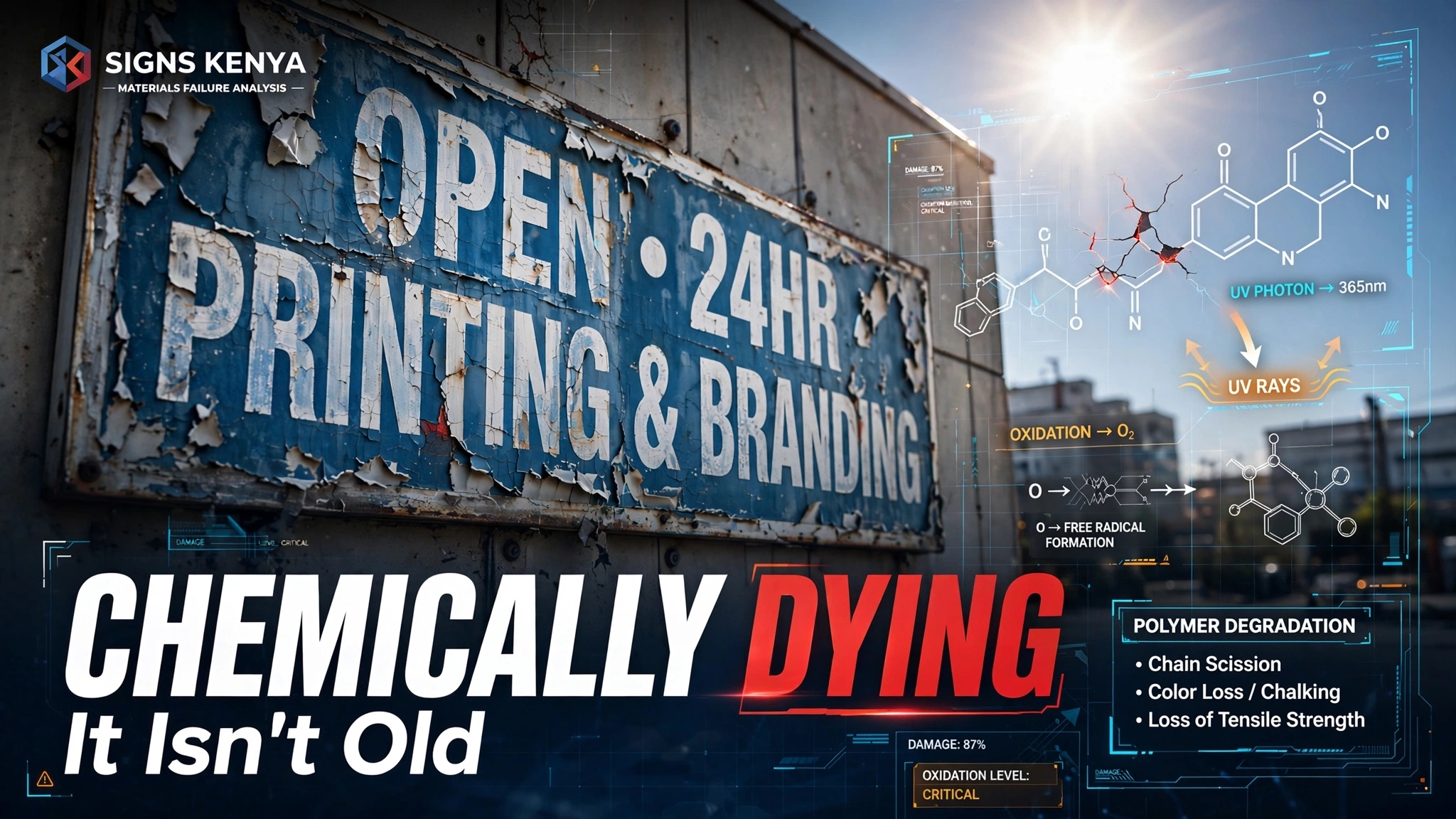
Stop for a second and look across the street at a business sign that’s been up for a couple of years. See that faded, washed-out pink that used to be a vibrant, deep berry red? Look closely at the surface. Does it look dusty, dry, or almost frosted?
Most business owners assume that’s just normal weathering. “It’s the sun,” they say. “It’s just the heat.”
That’s not entirely wrong—but it’s a massive oversimplification. That sign isn’t just drying out. It is undergoing a violent chemical reaction at the molecular level, and no amount of cleaning is ever going to bring that color back.
The science behind this decay is called photo-oxidation, and if you don’t understand it, you are essentially paying good money to install a sign that starts rot-curing the day it goes up.

1. The Equatorial Assault: Why Nairobi Is a Warzone for Polymers
We sit almost directly on the equator, and that location dictates everything about how a sign will age.
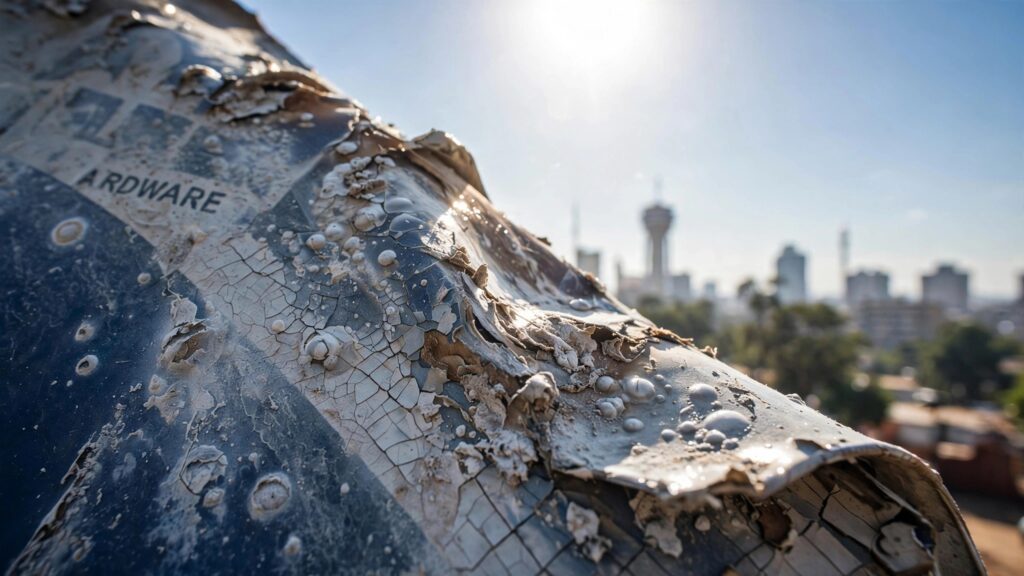
The UV radiation that hits Nairobi is significantly more intense than in temperate regions like Europe or North America. It’s not just the heat—it’s the specific wavelength of ultraviolet light (UVA and UVB) that reaches the ground. At our altitude and latitude, the sun doesn’t just warm the material; it literally breaks the chemical bonds holding the plastic and paint together.
This process is called polymer chain scission. Think of the surface of your sign as a long, tightly woven chain of molecules. When UV rays hit that chain, they shear individual links apart.
Now, add Nairobi’s humidity into the mix. High moisture content in the air—combined with the occasional bout of acid rain from urban pollution—accelerates this breakdown. The moisture seeps into the microscopic cracks that UV radiation creates, triggering a process called hydrolysis. The moisture literally eats the broken polymer from the inside out.
What you get is a phenomenon we call chalking. The sign turns dusty, the surface becomes brittle, and the vivid colors you paid for turn into a dull, grayish ghost of what they used to be.
2. The “Cheap Acrylic” Trap: UV Stabilizers Are Not Optional
Every acrylic sheet you buy has a specific additive embedded in it during the manufacturing process—a UV absorber.
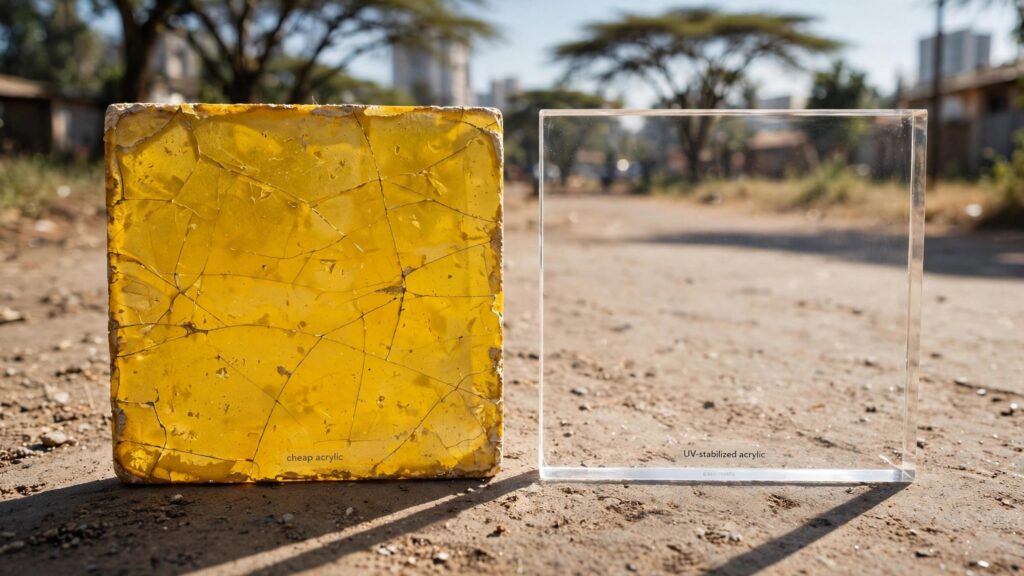
High-quality, UV-stabilized cast acrylic is manufactured with an additive that is mixed into the liquid resin before it is solidified. It acts like a microscopic sponge that catches UV rays and dissipates them as harmless heat before they can shatter the polymer chains.
Here is the catch: Cheap acrylic has either very low concentrations of this absorber, or it uses a coating rather than an embedded stabilizer. A coated UV layer will wear away in 18 months. The moment that coating scratches or washes off, the raw acrylic underneath is exposed.
When that unprotected acrylic hits the Nairobi sun, it doesn’t turn white overnight. It turns yellow. Because the chemical bonds responsible for blue and violet light absorption are the first to break down, leaving only the yellow wavelengths to reflect back to the eye.
We don’t use coated acrylics. We source material with a UV stabilizer embedded at a molecular level, rated to block 98% of all UV radiation for a minimum of 10 years. It costs us more per sheet. It costs you significantly less in replacement and repainting costs down the road.
3. The Digital Print Disappearing Act
If you have a large-format banner or a printed logo on your storefront, the fading happens even faster.
Digital printing inks are pigment-based. The tiny particles of pigment are suspended in a binder that adheres to the vinyl or PVC. But UV rays don’t just fade the pigment—they attack the binder itself. When the binder breaks down, the pigment particles lose their grip on the material and literally float off the surface.
This is why a printed banner that looks perfectly crisp in January looks like a faded watercolor painting by the following December. The ink is gone because the glue holding it died.
We counter this by specifying a two-part process: a high-quality, digitally printed graphic, followed by a specialized, heavy-duty anti-UV, anti-graffiti laminate. This laminate is a clear sacrificial layer. It takes the full brunt of the UV damage so the ink beneath stays saturated and vibrant.
4. The “Marine-Grade” Difference: Aluminum Never Forgets
For the physical structure of your sign—the frame, the letters, the fascia—metal choice is everything.
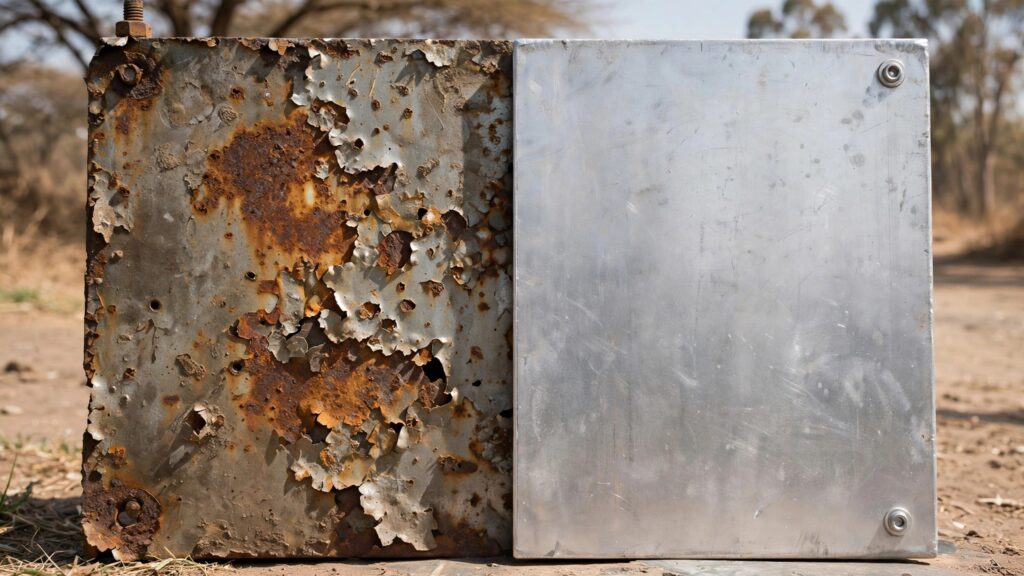
Standard commercial aluminum is treated with a basic industrial powder coat. It looks fine on delivery day, but humidity and UV rays eventually cause the coating to delaminate, allowing moisture to reach the bare aluminum, which instantly starts to pit and oxidize.
We use marine-grade aluminum and specify a PVDF (polyvinylidene fluoride) fluoropolymer coating for all exterior projects.
Fluoropolymer is the same material used to coat the exterior of commercial aircraft and offshore oil rigs. It is chemically inert, meaning UV rays physically bounce off it rather than penetrating the surface. It does not oxidize, it does not chalk, and it absolutely does not turn that dreaded chalky white.

5. What You Are Actually Buying (And Why It’s Cheaper in the Long Run)
When you hand us a project, we aren’t just looking at your logo. We are looking at the environment that logo is going to fight for the next five to ten years.
We don’t just ask, “What color do you want?” We ask, “How long do you want it to stay that color?”
You could save 30% today by buying cheaper acrylic and standard powder-coating. But in less than three years, you’ll be staring at a faded, yellowed, peeling eyesore that is actually hurting your brand perception. Your customers will see a tired sign and assume the business is equally tired.
We build for the long game. We embed the UV filters. We add the protective laminates. We spec the marine-grade aluminum.
It costs more upfront because the materials cost more upfront. But when that competitor sign down the street is looking washed out and forgotten, your brand will still be sitting there, looking exactly as crisp and professional as the day our installation crew packed up their tools.
A sign isn’t a one-time purchase. It is a ten-year investment in your brand’s visual integrity. We protect that integrity, one molecule at a time.